A Practical Guide to Aligning inspection scope with purchase specifications
An inspection is reliable when each check has a controlled requirement, a defined method, a recorded result, and an authorized decision route. Align the checklist with the purchase baseline before production is ready.
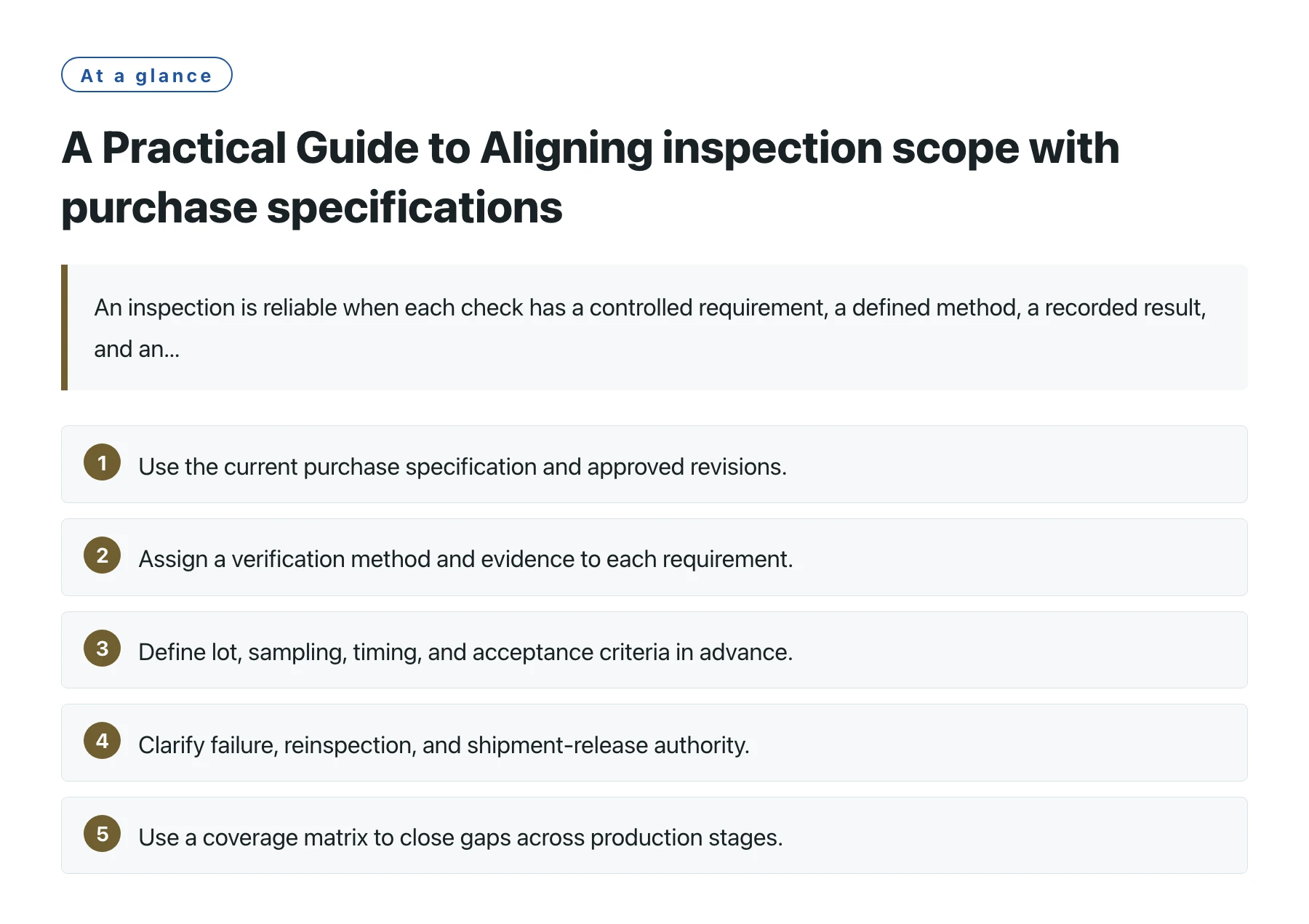
Key takeawaysUse the current purchase specification and approved revisions. · Assign a verification method and evidence to each requirement. · Define lot, sampling, timing, and acceptance criteria in advance. · Clarify failure, reinspection, and shipment-release authority. · Use a coverage matrix to close gaps across production stages.
A complete inspection scope prevents two common problems: important requirements with no check and checks with no agreed acceptance limit.
1. Start with the controlled purchase baseline
An inspection scope should trace directly to the purchase specification, approved drawings, sample records, and written changes. Collect current revisions and identify the item, order, variant, lot, destination, and delivery stage. Remove obsolete requirements from the working pack so the inspector is not asked to judge against conflicting versions.
Assign a requirement ID to each check and identify whether it is critical, major, minor, or informational for the decision at hand. If the purchase document uses subjective terms, have the buyer’s technical owner convert them to observable criteria before the visit. The inspector should apply an approved limit, not invent one during examination.
2. Classify requirements by verification method
Some requirements can be checked by observation, others by measurement, function test, document review, laboratory analysis, or supplier interview. Mark the method and evidence for each line. Include measuring equipment, units, setup conditions, test duration, and sample identity where results depend on them.
State which properties are outside the inspection scope. A visual pre-shipment check cannot establish hidden material composition or long-term life, and a document review cannot show current production condition. If a requirement needs a specialist or laboratory, plan that review separately and coordinate its result with the shipment decision.
3. Define the inspection lot and timing
Define lot boundaries by model, production run, component set, shift, or another traceable rule. Confirm when goods will be ready and whether inspection happens before packing, after packing, during production, or at the factory. If a lot is incomplete, state the quantity covered and what remains unseen.
Schedule inspection early enough to allow correction before the ship date. Ask the supplier to notify the buyer if production status or lot composition changes. The report should identify actual quantity and status on the visit date, not merely repeat the expected order quantity.
4. Select sampling and acceptance criteria
Agree sample-selection responsibility, method, size, inspection level if applicable, defect classes, acceptance limits, and treatment of replacements. ISO 2859-1 describes attribute sampling procedures indexed by acceptance quality limit; it does not define a universal quality promise. A qualified quality owner should select a suitable plan and record it in the instructions. [1]
For critical safety or functional requirements, decide whether every unit, a separate test, or another control is necessary. Keep sample-based decisions distinct from 100 percent checks. Do not use a familiar sampling table without checking whether the product risk, lot size, and contract support it.
5. Convert drawings and samples into inspection points
Extract dimensions, tolerances, materials, finish, labeling, accessories, fit, and functional criteria from the approved documents. Reference drawing zones or sample features so the inspector can locate what to check. Identify which features may be checked on a sample and which require records from production or an outside test.
Label the approved sample with order, model, revision, and approval date. State whether it is a visual reference, functional reference, or full configuration baseline. If it differs from current production, document what changed and whether the buyer has approved that difference before inspection.
6. Include packaging and shipment requirements
When packaging affects product condition or receiving, define carton construction, protection, marks, packing list reconciliation, pallet configuration, quantity per package, and required photos. Identify whether the inspector can open selected cartons and who authorizes resealing. Include cargo or loading checks as a separate task if needed.
Connect package identifiers with product lot and order quantity. Ask for special handling or storage limits that matter during transport and at the destination. An inspection scope should state whether loading, container condition, and seals are included; do not assume they are covered by a product checklist.
7. Prepare the inspector’s work instructions
Give the inspector an objective, schedule, factory address, safety and access instructions, contact list, language needs, photography permission, checklist, defect examples, and escalation triggers. Name who can approve a scope change or answer technical questions. Require the inspector to record evidence and identify unavailable tests.
Use concise criteria that can be applied consistently. Avoid directions such as “check quality carefully” without defining characteristics. If an inspector finds an unlisted issue, state how it should be reported and whether work stops pending buyer review.
8. Plan failure handling and corrective evidence
Define what happens after pass, fail, pending, and incomplete results. State who receives the report, response deadline, shipment hold status, and authority to accept a concession. The inspector should not release goods unless the contract delegates that decision.
For rework, specify how affected goods are identified, repaired, replaced, reinspected, and linked to original findings. Preserve first results and record any new sample. A supplier’s promise to correct later should remain an open action until evidence meets the agreed closure test.
9. Review scope coverage before the visit
Hold a short review with procurement, quality, engineering, and supplier contacts. Check that every high-priority purchase requirement has an inspection method or named alternative evidence. Confirm no requirement is duplicated with conflicting limits and that sampling assumptions are understood.
Use a coverage matrix to identify requirements that will be checked before production, during production, at final inspection, or on receipt. This prevents gaps between stages and clarifies which records must travel with the shipment. Update the matrix when the specification changes.
10. Connect findings to release and learning
The final report should reference requirement IDs, actual results, evidence, quantity, lot, limitations, deviations, and inspector identity. Review whether conclusions follow from results and whether critical checks were performed. Record authorized shipment release separately from the inspection outcome.
Teams arranging JS Sourcing inspection services in China can use a traceable scope to align the purchase specification, sampling plan, factory work instructions, and report. Confirm that every approved change is reflected in both the inspection pack and the final order record.
Sources
Frequently asked questions
How do I align an inspection checklist with a purchase specification?
Map each requirement to an ID, method, limit, sample or lot, evidence, and decision owner.
Who selects the sampling plan?
A qualified buyer-side quality owner should select or approve the plan based on product risk, lot, and contract.
Can an inspector decide whether shipment is released?
Only when that authority is explicitly delegated; otherwise the report supports the buyer’s named release decision.
What should happen when a test is outside the inspection scope?
Identify the gap, assign a qualified test or document review, and keep the related requirement open until evidence is reviewed.